
Beyond the “Fake”: Martyna Marciniak’s Artwork, Anatomy of Non-Fact, Explores Synthetic Images
Joël Chevrier has been a Physics Professor at Université Grenoble Alpes (UGA) since 1998. This article discusses artist Martyna Marciniak’s work, ‘Anatomy of Non-Fact’, which uses images moving from optical images (photography as it comes out XIX century) to non-optical images or synthetic images as generated by AI.
Martyna Marciniak: “to examine how design and technology shape ideologies and social structures”
In 2025, Martyna Marciniak is artist-in-residence at CERN in Geneva, in collaboration with Copenhagen Contemporary. CERN introduces her practice as follows: “Marciniak’s interdisciplinary practice combines spatial storytelling, speculative fiction and 3D reconstruction to examine how design and technology shape ideologies and social structures.” Her work, rooted in the present moment, draws attention to the immense and irreversible transformation of the world brought about by the powerful alliance of design, technology and science—what we might call “the Tech”. Her work raises pressing questions: who is truly able to control, or even measure—let alone anticipate—these sweeping transitions?
A Pope in a Balenciaga puffer? That doesn’t exist…
In 2023, an image appeared showing Pope Francis clad in a white Balenciaga puffer coat. The image went viral, far beyond the expectations of its creator, Pablo Xavier, a passionate user of the AI tool MidJourney. For him, this synthetic image was clearly a “fake”, a playful product of his experiments with AI. But for much of the world, it wasn’t recognized as such. People failed to grasp the scale and violence of the transition underway. The rapid production and instantaneous global dissemination of synthetic images has become accessible to everyone, requiring no training or particular skill. In her work Anatomy of Non-Fact, Martyna Marciniak explores, as an artist, this radical shift in our relationship to the image.
Photographic or optical images versus synthetic or non-optical images
Synthetic images are entirely shaped by XXI century science and technology. But unlike photographs—here named optical images—there is no need to capture a real-world scene. Nineteenth-century photography enabled the recording of optical images on a screen through chemical and physical engineering. It is a process rooted in real interactions between light and matter. Photography is physically constrained: reality imposes itself on the image. This is no longer the case with synthetic imaging. Its foundations lie in nanotechnology, computing, big data processing, and thus AI. It manipulates digital data on a digital screen—the image’s substrate—and can generate any conceivable image. Thanks to AI, what appears on the screen is exactly what the creator intends, down to the last pixel. Total freedom.
A “mise en abyme”: a fake Pope in a Balenciaga puffer—clearly fake, but still real
In a video trailer titled AI Hyperrealism, Martyna Marciniak presents a real person who strongly resembles Pope Francis, dressed in an actual Balenciaga puffer. She thus takes Pablo Xavier’s synthetic fake one step further, anchoring the imaginary scene he created in the physical world through a staged re-enactment. Yet it remains a fake—it is not the real Pope Francis, still alive at the time, strolling about at Marciniak’s behest. What we see is a real-life scene, filmed in the traditional way. This optical image becomes a faithful recording of the material incarnation of an entirely artificial “synthetic image”—what Marciniak calls a “post-optical” or “non-optical” image. And yet it is astoundingly convincing. The “mise en abyme” is dizzying.
The first age of the image: drawing, painting and engraving
Marciniak’s term “non-optical image” highlights a pivotal shift in image-making that began with the invention of photography in the 19th century. Before that, humanity’s images were hand-drawn, painted or engraved. Artists placed on a surface what they intended to represent. Their only constraint was technical, though often a demanding one: a painter could only paint what they were capable of rendering. This work on the “appearance of reality”, regardless of style—from Botticelli to Rembrandt to Picasso—fills the world’s museums. A multitude of styles, histories, narratives and revolutions bears witness to the extraordinary richness of human visual creation.
The second age of the image: Joseph-Philibert Girault de Prangey and the first optical images of Athens
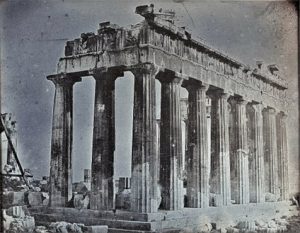
North facade and colonnade of the Parthenon on the Acropolis, Athens.
Daguerreotype by Joseph-Philibert Girault de Prangey (1842)
Following the 1839 invention of photography by Nicéphore Niépce and Louis Daguerre, image quality and recording techniques advanced at lightning speed. By the 1840s, Joseph-Philibert Girault de Prangey was producing the first photographic images of Athens, Jerusalem, and Cairo. Roger Fenton photographed the Crimean War in 1855. War photographers have since risked their lives to document conflicts around the globe. Robert Capa’s brutal maxim still resonates: “If your pictures aren’t good enough, you’re not close enough.”
For nearly two centuries, photography remained the gold standard. To most, a photograph was indisputable evidence of reality. Of course, some images were doctored—but doing so was technically complex, and such efforts merely reinforced the status of optical images, their truth-value guaranteed by physics and chemistry.
The third age of the image: From optical to synthetic images in the 21st century
Today’s billions of smartphones have exploded the number of photographs—optical images—being produced. But now these photographs exist within a wider ecosystem of synthetic imagery. Every photo can be digitally altered at the moment of capture or after. The distinction between photographic and synthetic images grows harder to discern, but synthetic images are fast becoming the norm. In this early 21st century, one might feel we’ve returned to the era before photography—when all images were purely human-made. Indeed, the image-maker is once again fully in control. With AI, one can define every aspect of the image, pixel by pixel. But this is not a simple return to the past, and Marciniak’s work makes that very clear.
The synthetic image: between painting and the photographic image?
In the 19th and 20th centuries, photography swept everything before it, offering a faithful depiction of reality, swift execution, ease of use, mass reproduction and dissemination. Yet now photography—an optical image—may itself be swept away by the rise of synthetic, non-optical imagery. With Anatomy of Non-Fact, Martyna Marciniak confronts us with an even deeper abyss. Deliberately so? We have no reason to doubt that her video was made with an actor, a set and a camera. She tells us so—we can take her word for it. But how can we truly be sure? If she had instead generated the video using AI, would we be able to tell? And more importantly, would it make any difference…?
Beside Martyna Marciniak, do we need help of French sociologist and philosopher Jean Baudrillard to explore fake news or alternative facts?
In his book Simulacra and Simulation (1961) the French philosopher and sociologist Jean Baudrillard wrote:
“Thus, feigning or dissimulating leaves the reality principle intact: the difference is always clear, it is only masked; whereas simulation threatens the difference between “true” and “false”, between “real” and “imaginary”.”
Returning to this work, Simulacra and Simulation, in order to follow Martyna Marciniak more closely, one is struck by the fact that, in the era of synthetic images — themselves performative in the real and/or virtual world — the very notions of fake news or alternative facts are not defined in relation to reality or truth.
Jean Baudrillard had already introduced four successive phases of the image.
“These would be the successive phases of the image:
1 – It is the reflection of a basic reality.
2 – It masks and perverts a basic reality.
3 – It masks the absence of a basic reality.
4 – It bears no relation to any reality whatever: it is its own pure simulacrum.”
« In the first case, the image is a good appearance: the representation is of the order of sacrament. In the second, it is an evil appearance: of the order of malefice. In the third, it plays at being an appearance: it is of the order of sorcery. In the fourth, it is no longer in the order of appearance at all, but of simulation. »
Images produced by AI have long surpassed level two, passed level three, and have probably reached level four.
Baudrillard’s book opens with a quote from Ecclesiastes, which is in fact entirely his own invention: “The simulacrum is never that which conceals the truth–it is the truth which conceals that there is none.”
The simulacrum is true.
The article was written by Joël Chevrier, a LCC member of Studiotopia project, as part of the project’s study visit. The original version of the article was published at Interalia Magazine. The French version of the article is available on this link.